The Short Cut
- Mitochondria convert oxygen and fuel into ATP, the energy that powers muscle contraction.
- A marathon is almost entirely aerobic. Mitochondrial function is central to how well you sustain pace.
- Training increases mitochondrial quantity, improves network quality, and positions fat stores closer to the machinery that burns them.
- In elite athletes, fat droplets sit two to three times closer to mitochondria than in recreational runners. This helps explain superior fat burning at race pace.
- Easy running and long runs drive most mitochondrial adaptation. Intervals help but are less effective than volume for blood vessel density, which marathon running also requires.
- Better fat utilisation spares glycogen. That is a physiological reason, not just experience, why seasoned runners manage the second half of a marathon more effectively.
Most runners have heard about VO₂max. Fewer have spent much time thinking about what sits beneath it: the microscopic structures inside muscle cells that determine how well those cells can actually use oxygen. Mitochondria are not a training concept or a supplement marketing claim. They are physical objects, present in their millions inside each muscle fibre, and what happens to them over years of training goes a long way to explaining why some runners hold pace at 35 kilometres while others fall apart.
Understanding the basics is worth the effort. The science has moved considerably beyond the old picture of simply "building more mitochondria," and the newer findings carry genuinely practical implications for how marathon training works and why the fundamentals of it are so hard to improve upon.
What Mitochondria Do
Mitochondria take oxygen, delivered to the muscle via the cardiovascular system, and use it to convert carbohydrate and fat into adenosine triphosphate, or ATP. ATP is the immediate fuel of muscle contraction. Every stride you take requires a fresh supply of it, and when the supply falters, pace goes with it.
A marathon is almost entirely an aerobic event. Sprint events draw heavily on anaerobic pathways, which can produce ATP without oxygen but only in limited quantities and for short durations. By the time a runner settles into marathon pace, the vast majority of energy is coming from oxidative metabolism: oxygen in, ATP out, sustained across 42.2 kilometres. The aerobic system is the only one capable of maintaining that output for two to six-plus hours, and aerobic energy production happens inside mitochondria.
The practical consequence is simple enough. Better mitochondrial function means more ATP produced per unit of oxygen consumed, less physiological strain at a given pace, and a longer window before fatigue accumulates to the point where it starts costing time.
Beyond Counting Power Stations
Older training literature treated mitochondrial development as an accumulation problem. More mitochondria meant more aerobic capacity. Train more, build more, run faster. That logic is sound as far as it goes, but it describes only part of what actually happens.
Current research frames the process as mitochondrial remodelling. Training changes not only the number of mitochondria within muscle fibres but how they are organised, how efficiently they function, and how well they interact with other structures inside the cell. Mitochondria are not fixed objects. They undergo three continuous maintenance processes: fusion, where individual mitochondria merge to share resources; fission, where they divide; and mitophagy, where damaged or inefficient mitochondria are broken down and recycled. The result is less a collection of isolated generators than a dynamic network that repairs and reorganises itself in response to the demands placed on it.
Two runners with similar mitochondrial counts can have meaningfully different aerobic capacity if one has a better-maintained, better-organised network. Training adds to the engine room. It also rebuilds it.
How Training Changes the System
The training principles that produce successful marathon performances are the same ones the mitochondrial system responds to most effectively. This is not a coincidence.
Easy aerobic running creates a sustained demand for aerobic energy production, which signals the body to increase mitochondrial content and improve ATP generation efficiency. The case for high-volume, predominantly easy training in marathon preparation is often made in terms of injury prevention or mental freshness. The cellular case is at least as strong.
Long runs place extended demands on aerobic metabolism and specifically on fat utilisation. Over weeks and months, they improve the muscle's capacity to use fat as a fuel source during prolonged effort. Fat oxidation happens inside mitochondria, and a more developed system handles it more effectively at higher running speeds.
Threshold running, at or near the pace where lactate accumulates faster than the body can clear it, challenges the aerobic system at higher intensities while remaining sustainable for meaningful durations. These sessions improve the capacity to produce energy aerobically at speed.
High-intensity interval training produces significant mitochondrial adaptations with considerably less training time. A systematic review published in Sports Medicine in 2025, drawing on data from nearly 6,000 participants across 353 studies, found that endurance training, high-intensity interval training, and sprint interval training all increased mitochondrial content to a similar degree when overall training load was properly accounted for. For marathon runners, intervals complement aerobic mileage rather than substitute for it. The same review found that capillarisation, the density of the small blood vessels delivering oxygen and fuel to muscle fibres, responded better to sustained aerobic volume than to interval work. Capillarisation is a separate adaptation, and an important one for long-distance running. It favours the long run.
The Lipid Droplet Finding
Recent research has identified something about how mitochondria relate to the fat stores inside the muscle cell that changes the picture somewhat.
Muscle cells store fat in structures called lipid droplets. Endurance training increases the amount of fat stored this way, which has been understood for some time. What was less clear was whether the physical proximity of those droplets to mitochondria had any bearing on performance.
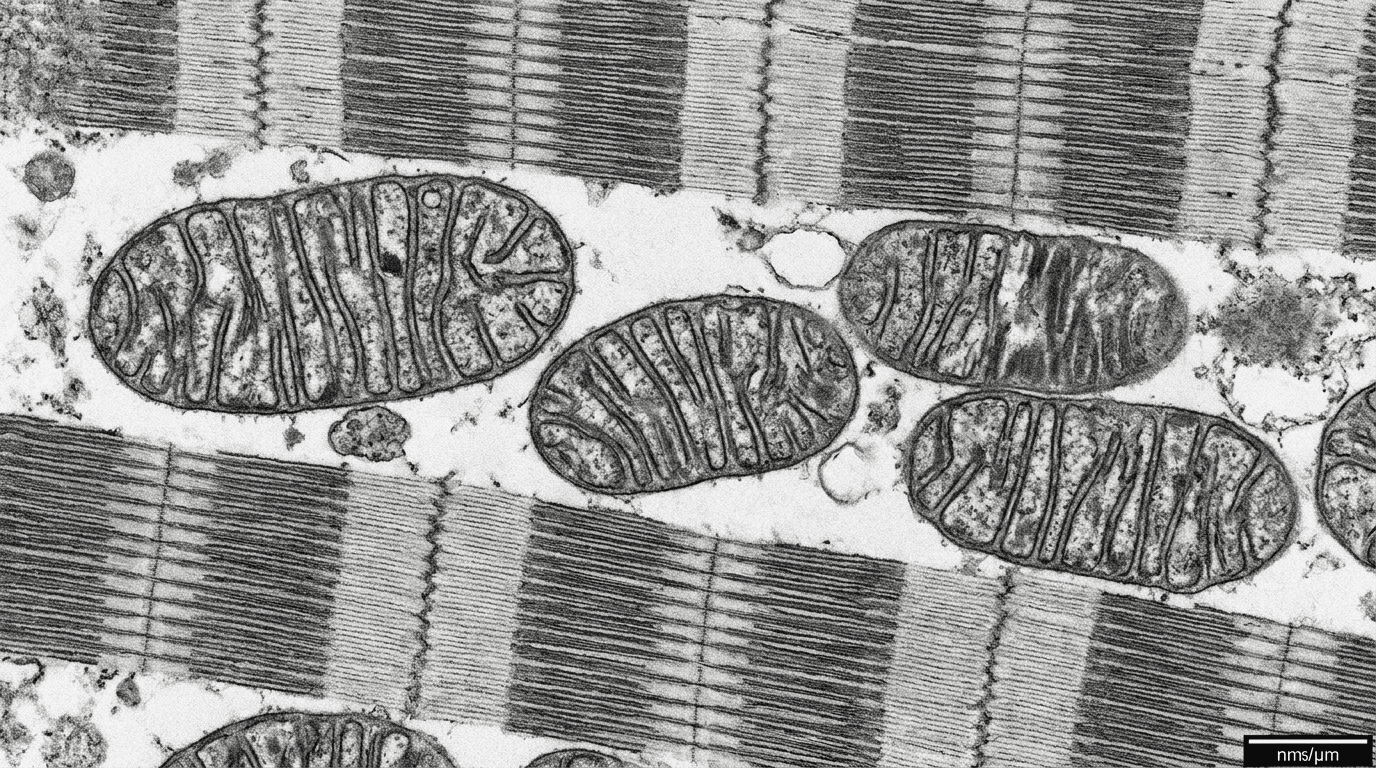
A 2025 study from the University of Southern Denmark examined skeletal muscle biopsies from 17 elite triathletes and road cyclists alongside 7 recreationally active men. Using transmission electron microscopy, an imaging technique with sufficient resolution to examine individual organelles, the researchers measured the total contact length between lipid droplets and mitochondria in each sample. The elite athletes had two to three times greater contact length than the recreational group. This was partly because they had more mitochondria, around 30% more, but the lipid droplet density in the relevant muscle region was twice as high in the athletes, and the spatial organisation of both structures differed. The mitochondria were, in effect, positioned closer to the fuel they needed to burn.
This finding offers a structural explanation for something exercise physiologists refer to as the athlete's paradox: elite endurance athletes store more fat inside their muscle cells than sedentary individuals, which is counterintuitive, while simultaneously being more effective at burning it. Physical proximity between fuel and the machinery that processes it appears to be part of the reason. The mechanisms are not fully understood, but the finding adds a spatial dimension to what had previously been described mainly in terms of enzyme activity and mitochondrial volume.
The Wall, Explained
The loss of pace that tends to occur between 30 and 35 kilometres is fundamentally a glycogen story. Glycogen is how the body stores carbohydrate, held in the muscles and liver. Muscle glycogen can only be used by the muscle that contains it. Liver glycogen can be released into the bloodstream for wider use. Between them, trained runners begin a race carrying roughly 400 to 500 grams. At marathon pace, that supply runs out.
Mitochondrial development affects this indirectly but materially. As the aerobic system improves with training, fat oxidation at a given running speed increases. Body fat stores are large relative to glycogen stores, so every kilojoule the working muscle can extract from fat is one it does not need to take from glycogen. A runner with a well-adapted mitochondrial system depletes glycogen more slowly and arrives at 35 kilometres with more in reserve than a runner of comparable fitness whose aerobic adaptation is less developed.
This is not a reason to neglect race fuelling. No level of mitochondrial development removes glycogen dependency at marathon intensities. The wall remains a genuine risk for runners who go out too fast, fail to take on carbohydrate during the race, or arrive undertrained. The metabolic flexibility that accumulates over years of consistent aerobic work is one of the real physiological differences between an experienced marathon runner and someone running the distance for the first time. Experienced runners tend to manage fuel better over the second half of a marathon. Their fuel systems are more efficient. The pacing wisdom follows from that, rather than the other way around.
The Signalling Question
Recent research has begun to examine something beyond the mitochondria themselves: the role they play as active participants in the muscle cell's adaptation process.
When you run, energy balance in the muscle is disrupted. The cell responds by activating molecular signals, among them protein kinases, which are enzymes that switch other proteins on or off by attaching phosphate groups to them. These signals travel between the mitochondria, the cell nucleus, and various other structures, and collectively they drive the adaptations that follow training. Mitochondria are not passive recipients. They contribute to the signalling process and influence which genes are activated in response to exercise.
PGC-1 alpha, formally peroxisome proliferator-activated receptor gamma coactivator 1-alpha, is a protein that helps regulate gene expression and acts as a key driver of new mitochondrial protein production. Exercise increases its activity. Research published in Sports Medicine in 2024 found that the signalling network involved in this process is considerably more complex than PGC-1 alpha alone: a broader set of kinases and molecular switches are involved, and how they interact with each other and with the mitochondrial network is still being worked out.
For runners, the practical consequence is that mitochondrial adaptation depends not only on training volume or intensity in isolation. The signals that drive it are sensitive to the nature of the stimulus, how frequently it is applied, and how much recovery exists between sessions. Marathon training plans built on consistent easy running, well-timed quality sessions, and genuine recovery are structured that way for reasons that extend well beyond convention. They deliver the right signals, repeatedly, without exhausting the system's capacity to respond to them.
Related reading: The glycogen story that connects mitochondria to race performance is covered in practical terms in The Golden Rules of Glycogen and Race Morning Fuel. For how these aerobic adaptations translate into race performance, Marathon Times Are Changing Fast covers the elite performance data. The courses that reward aerobic efficiency most directly are the flat, fast ones where economy rather than strength is the differentiator: the Berlin Marathon and Rotterdam Marathon race pages include course profile data and typical finishing time distributions.
The Extra Mile
Reisman EG, Hawley JA, Hoffman NJ. Exercise-Regulated Mitochondrial and Nuclear Signalling Networks in Skeletal Muscle. Sports Medicine. 2024;54:1097–1119.
Mølmen KS, Almquist NW, Skattebo Ø. Effects of Exercise Training on Mitochondrial and Capillary Growth in Human Skeletal Muscle: A Systematic Review and Meta-Regression. Sports Medicine. 2025;55:115–144.
Nielsen J, Petersen KG, de Almeida ME, Shepherd SO, Christensen B, Petersen MH, et al. Increased Contact Between Lipid Droplets and Mitochondria in Skeletal Muscles of Male Elite Endurance Athletes. American Journal of Physiology — Cell Physiology. 2025;329(1):C1–C16.
Zhao YC, Gao BH. Integrative Effects of Resistance Training and Endurance Training on Mitochondrial Remodeling in Skeletal Muscle. European Journal of Applied Physiology. 2024;124(10):2851–2865.
Spriet LL. Regulation of Substrate Use During the Marathon. Sports Medicine. 2007;37(4–5):332–336.