The Short Cut
- Guide running began as a way to support visually impaired athletes on the road, and remains essential for that community.
- It has expanded to support runners navigating invisible barriers too: anxiety, sensory processing difficulties, clinical depression, PTSD, and the simple intimidation of a mass-participation start line.
- For guides as much as athletes, the experience tends to change what running means. Crossing a finish line as a pair produces something qualitatively different from a solo finish.
- Several organisations match guides with athletes in the UK, US, and Australia. Training and support are provided.
Moving Beyond a Single Set of Eyes
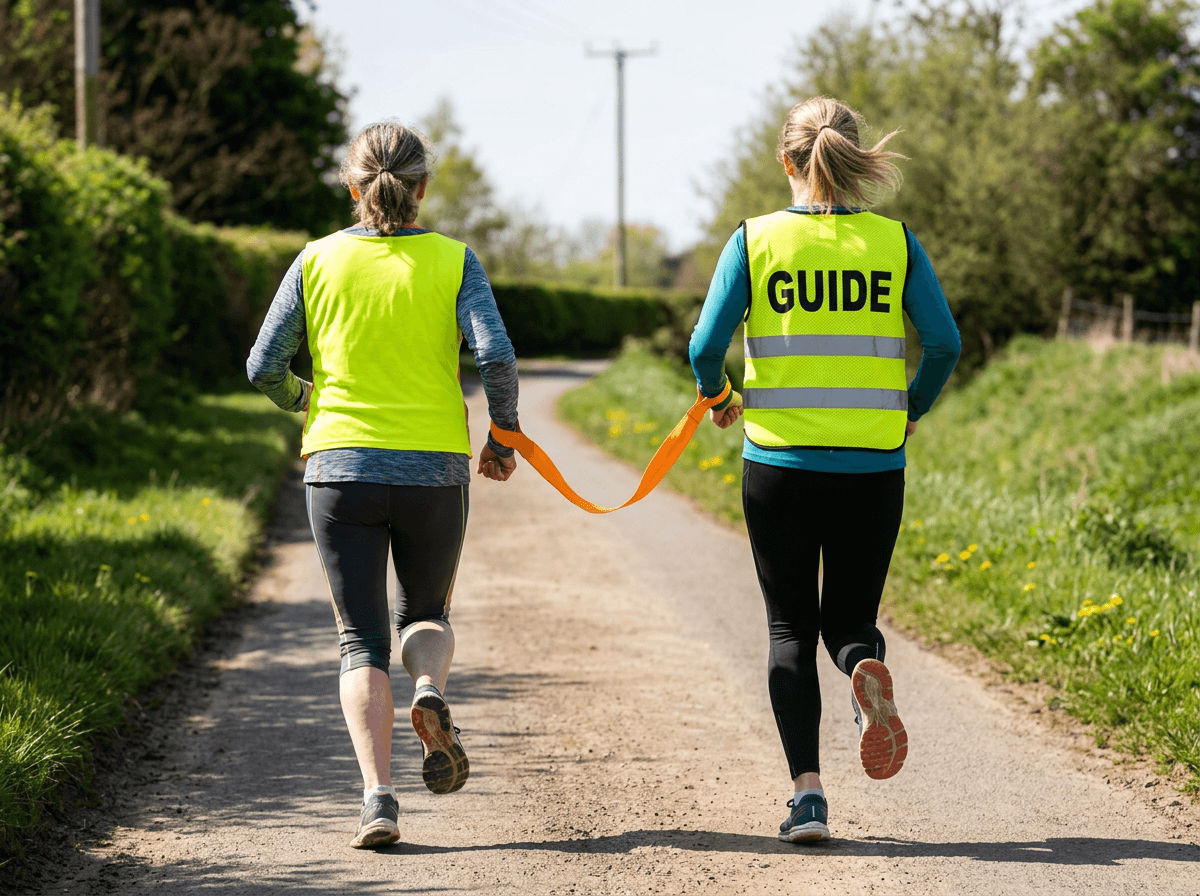
For many people, guide running calls up a specific image: two runners moving in close synchronisation, linked at the wrist by a short fabric tether. That remains central to the sport, particularly for athletes with sight loss. But the scope has expanded.
Guide running is now a support structure for runners who face barriers that are not visible from the outside. For individuals managing severe anxiety, panic disorders, clinical depression, complex PTSD, or neurodivergence, a mass-participation starting line can feel genuinely overwhelming. The noise, the shifting crowd, the sensory intensity of thousands of moving bodies: any of these can block access to a sport that would otherwise help.
In that context, a guide runner is not a directional compass. They function as a grounding anchor, a predictable, calm presence that buffers the sensory environment, helps manage crowd spacing, and allows the athlete to settle into a secure, rhythmic stride. The only requirement of the partnership is moving forward together.
What the Guide Gets Out of It
The pairing works in both directions. For the athlete receiving support, it means regaining, or discovering, access to the road, the local park, or the finish line of a major marathon. For the guide, the experience is often transformative in ways that are harder to predict.
Stepping into the role requires shedding the usual preoccupations: personal times, pacing ego, the low-level competition that colours even casual running. When your primary focus is someone else's safety and experience, your relationship with the miles changes. Guides frequently describe paying closer attention to the texture of the world around them, the camber of the road, changing light through trees, obstacles the other runner cannot see, and finding unexpected satisfaction in that kind of presence.
Crossing a finish line as a pair, where the medal belongs to the partnership, produces something qualitatively different from a solo finish. The race becomes a shared story rather than a personal record.
Guide Running at Every Level
At a local parkrun, guide running is an accessible way to give back to the running community on a weekly basis. It provides a consistent touchpoint of routine and connection, allowing slower joggers, walkers, and adaptive runners to participate safely and without self-consciousness.
At the scale of a major marathon, it deepens considerably. Navigating 42.2 kilometres as a unified team transforms the course into an experience built around partnership. The logistics alone, managing a tether, maintaining communication, anticipating the route, demand a level of sustained attention that most solo runners never develop.
Getting Started
Several established organisations match guides with athletes and offer training for new volunteers.
In the UK, England Athletics runs Sight Loss Awareness and Guide Running workshops. Run Talk Run is a grassroots international network hosting low-pressure group runs specifically designed to make running accessible for people managing mental health difficulties.
In the US and Canada, United in Stride operates a free matching platform pairing blind and low-vision athletes with local guides based on location, pace, and goals.
Achilles International operates across more than 70 countries, providing adaptive equipment, organised training, and volunteer guide pairings for everything from local park runs to major international marathons.
In Australia, Achilles Australia manages active chapters in Sydney, Melbourne, Brisbane, Canberra, and the Hunter Central Coast.
Related reading: Many major marathons have established guide runner programmes. The London Marathon and Sydney Marathon race pages include information on entry allocations for athletes and guides. For accessible races more broadly, the Tokyo Marathon and Chicago Marathon both operate dedicated adaptive athlete entry categories.
The Extra Mile
England Athletics. Guide Running. Resources and workshop listings for prospective guides in the UK.
United in Stride. unitedinstride.com. Free athlete-guide matching across North America.
Achilles International. achillesinternational.org. Programmes across 70+ countries, including major marathon participation.
Run Talk Run. runtalkrun.com. Low-pressure group runs for runners managing mental health challenges, available internationally.
Guide running in a mental health context requires patience, open communication, and active listening. Volunteer guides are support partners rather than medical professionals. All participants should ensure their activity aligns safely with any healthcare guidelines they are following.