The Short Cut
- The runners you compete against in older age groups are a self-selected group. Most people who started running in their twenties and thirties have since stopped. The ones still racing in their fifties and sixties are disproportionately the durable, the consistent, and the injury-resistant.
- This makes the bar higher than it would be in a random sample of all people your age. It does not make it unfair.
- GFA standards at London are set against a fixed allocation of 6,000 places, awarded fastest-first. Meeting the published time no longer guarantees entry. The effective threshold keeps rising as participation grows.
- Long-term training preserves VO₂max, running economy, and aerobic capacity far better than age alone would predict. The oldest runners in competitive fields are not just survivors. They are also well-adapted athletes.
- Running economy, the efficiency with which you convert oxygen into forward motion, declines less with age than VO₂max does in trained runners. This is an underappreciated advantage for older athletes who have trained consistently.
- The practical levers remain injury prevention and training consistency. Both determine whether you stay in the filtered field or drop out of it.
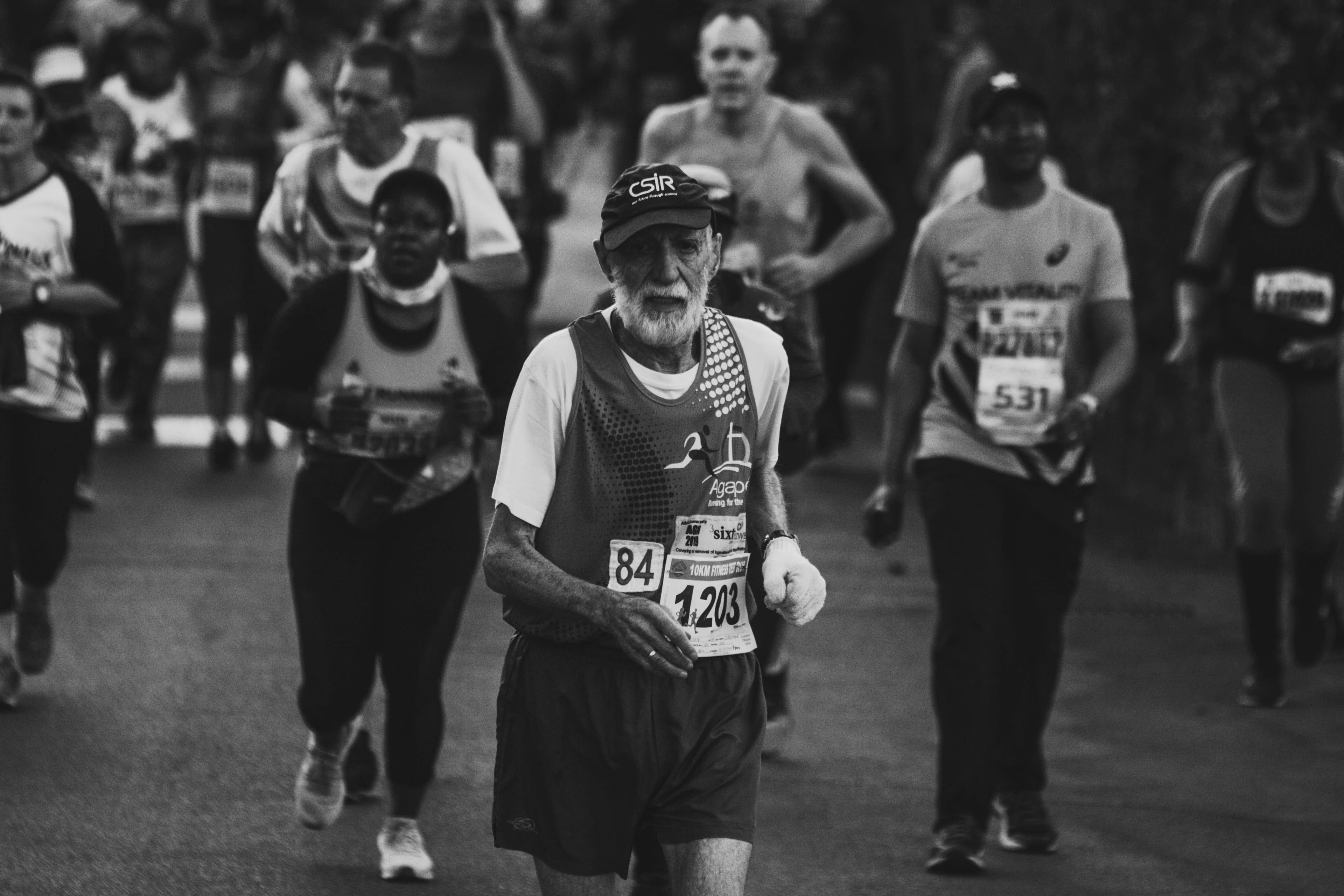
Ask most runners what makes GFA harder as they age, and they will tell you that their legs are slower, their recovery takes longer, and the standards keep getting tighter. All of that is true. What fewer consider is the nature of the field they are being measured against: older age groups in marathon running are not a representative sample of people that age. They are what remains after decades of attrition.
The theory has a name in research literature: selection bias. It is real. Understanding what it actually means, and what it does not mean, changes how you think about your prospects at 55 or 65 in ways that raw time standards do not capture.
Who Is Still Running
Marathon participation by masters athletes, broadly defined as those aged 40 and over, has grown substantially over the past three decades. At major races, masters runners now represent more than half of all male finishers and approaching half of all female finishers. The numbers are larger than they were. The composition of those numbers, however, is not random.
Running has a high injury rate. Studies suggest that up to 70% of endurance athletes sustain an injury significant enough to disrupt their training at some point. Over a span of twenty or thirty years, injury, illness, life demands, and lost motivation remove large portions of any cohort that started running together. The runners who persist into their fifties and sixties are not a typical cross-section of people that age. They are the ones who stayed healthy enough to keep training, motivated enough to keep entering races, and structurally suited enough to absorb decades of impact loading without accumulating damage that stopped them.
The academic literature on this has a useful formulation. Research into age-related performance trends notes that studies based on top-ranked or record performances largely overcome the dropout problem because they track only the best performers regardless of age. But for mid-pack masters runners competing for GFA places, the field they race against is precisely that filtered group: not world record holders, but the subset of ordinary runners who have simply kept going. That subset skews faster, more resilient, and more experienced than the wider population of people their age.
In plain terms: the person who ran a 3:45 at 35 and is now 58 and still running 3:50 is not competing against all 58-year-olds. They are competing against the 58-year-olds who also ran through their forties and fifties without stopping. That is a fundamentally different group.
But It Is Not Just Survival
Selection alone does not explain what older competitive runners can do. The research is consistent on this: long-term training produces genuine physiological adaptations that are not simply a matter of who was fittest to begin with.
VO₂max, the maximum rate at which the body can consume oxygen during exercise and one of the primary determinants of endurance performance, declines with age in everyone. The rate of that decline, however, is closely tied to training volume. Longitudinal studies of masters endurance athletes show VO₂max declines ranging from 5% to 46% per decade, with the variance explained largely by changes in training load. Roughly 54% of the observed VO₂max decline in male masters athletes is accounted for by reductions in training volume, not by biological aging alone. Athletes who maintain training volume and intensity preserve aerobic capacity at a rate that significantly outpaces their sedentary peers.
Muscle mass declines with age at approximately 1% per year from middle age onward. The rate accelerates: by the mid-seventies, longitudinal studies show mass is being lost at around 0.8 to 1% per year in men, with strength declining two to five times faster than mass. For runners, strength loss is the more functionally relevant figure. These are population averages, however, and trained runners consistently fall below average rates of loss.
Running economy, the oxygen cost of running at a given pace, is where the picture becomes most interesting for older athletes. Unlike VO₂max, running economy does not decline significantly with age in runners who maintain consistent training. Studies comparing highly trained masters athletes in their late fifties with younger trained athletes find no meaningful difference in economy at matched paces. This matters because economy partially offsets VO₂max decline: a runner whose aerobic ceiling has dropped but who moves efficiently still runs faster, at a lower physiological cost, than their raw VO₂max figure would suggest.
The implication is that older runners in competitive fields are not simply survivors of an original cohort. They are athletes whose physiology has been shaped by decades of consistent stimulus. The two effects, selection and adaptation, compound each other. The runner who stayed healthy enough to keep training also accumulated the adaptations that come from decades of training. Both factors operate simultaneously, and they are difficult to separate cleanly.
How GFA Standards Actually Work
The original article described GFA standards as being set using race data from runners who are actually competing, which is broadly accurate. The operational mechanics, however, are more complicated and more relevant to a runner assessing their own prospects.
At London, GFA is not a guaranteed entry. There are 6,000 places available, split equally between men and women, and they are allocated on a fastest-first basis within each age group. Meeting the published qualifying time gives you the right to apply. Whether that application succeeds depends on how many faster runners in your age group also applied. In practice, the effective qualifying threshold has been rising year on year as masters participation has grown and more runners hit the published standards.
For 2026, London tightened its published GFA times by three minutes for men and two minutes for women across all age groups. This adjustment did not reflect a change in what older runners are physiologically capable of. It reflected demand management: too many runners were qualifying for a fixed number of places. The allocation cap is the binding constraint, not the physiology.
Boston operates differently but faces the same pressure. The qualifying standards for the 2026 race were reduced by five minutes across all age and gender groups, the largest single tightening since 1990, again driven by the volume of runners achieving the published times rather than by any reassessment of what masters runners should be able to run.
This means that the challenge facing a 55-year-old targeting GFA has two distinct components. One is physiological: can they run fast enough? The other is competitive: even if they can, are they fast enough relative to the other runners in their age group who also qualified? The second question is the one that selection bias most directly affects. The more the field is filtered, the higher the de facto standard, independent of what London Marathon Events prints on the entry page.
The Longitudinal Problem
Most studies of age-related performance decline use cross-sectional data: they compare different runners at different ages and draw conclusions about how performance changes over time. The approach has a known weakness. Runners in their sixties who appear in race results are not a representative sample of all runners who were active in their thirties. They are the ones who kept going.
This creates an interpretive problem that the research community has not fully resolved. Some researchers argue that selection bias causes cross-sectional studies to underestimate the true rate of age-related decline, because the older cohort has been filtered to remove weaker performers. Others argue that studies based on best-ever performances are largely immune to this problem. The debate is ongoing, and the honest position is that the exact magnitude of the selection effect in marathon running is not precisely quantified.
What is clear is that cross-sectional data, which underpins most of the age-grading tables used to set GFA standards, compresses the distinction between two things that are genuinely different: how performance declines in a given individual as they age, and how performance differs between younger and older runners in a race field at a single point in time. The former is a biological question. The latter is a question about who is still racing.
For a runner trying to calibrate their own expectations, this distinction has practical value. The standards they are measured against reflect the field that exists, including its selection effects. Their own trajectory, if they stay healthy and keep training, may well be more gradual than the cross-sectional curves suggest.
What This Means in Practice
The selection effect in older age groups is real. It makes GFA harder than it would be if the field included all people of that age. It does not make GFA impossible, and it does not make the standards arbitrary.
Injury prevention is probably the most underrated element of long-term GFA viability. The runners who hit GFA standards at 60 are predominantly the ones who did not spend their fifties accumulating structural damage. This is partly luck and partly management: training load, recovery, strength work, and the willingness to ease back when something is wrong rather than racing through it.
Training consistency matters more than any individual training cycle. The physiological evidence on VO₂max, running economy, and mitochondrial function all points to the same conclusion: the adaptations that preserve performance into later age accrue over years and decades, not over a single build. A runner who has averaged 50 kilometres a week for fifteen years carries a different aerobic infrastructure than one who has done three hard training blocks separated by long gaps.
The pace of decline can be managed but not stopped. A realistic trajectory for a well-trained masters runner is a gradual slowing of perhaps 0.5 to 1% per year in performance terms, with acceleration after the mid-seventies. For a runner in their fifties, this means GFA is a moving target in two directions at once: their own times are slowly rising, and the effective qualifying threshold may also be rising as more runners chase the same fixed allocation. Staying ahead of both trends requires training that specifically addresses the physiological components most vulnerable to age: strength, running economy, and the high-end aerobic work that VO₂max depends on.
None of this makes the older field easier to beat. But it does clarify what the competition actually is: not all people of your age, and not an arbitrary standard set by administrators, but the filtered, adapted, and motivated subset of runners who have been doing this as long as you have.
The Short Answer
Yes, survival of the fittest affects your GFA prospects. The older field is harder than a random sample would be, because it consists of people who stayed healthy, kept training, and absorbed decades of running without stopping. That is the field the standards are set against.
It is also true that those same runners are not merely lucky survivors. They are physiologically adapted in ways that training produces over long periods. Running economy, aerobic capacity, mitochondrial function: all of these are better in runners who have trained consistently than in those who have not, at every age.
Your prospects depend less on where you rank among all people your age and more on whether you remain in the filtered field: healthy, training, and consistent. The selection effect that makes GFA harder is also, viewed from the other side, a description of what keeping your place in the older competitive field requires.
Related reading: For the full entry picture at London, including GFA qualifying times, the charity route, and the second-chance ballot, see How to Get Into the World Marathon Majors. The mitochondrial adaptations that underpin aerobic performance in older runners are covered in detail in The Engine Room. For masters runners planning a qualifying attempt, the Berlin Marathon and Valencia Marathon are the two most popular courses in Europe for time qualification, with flat profiles and reliable autumn conditions.
The Extra Mile
Trappe S. Marathon Runners: How Do They Age? Sports Medicine. 2007;37(4–5):302–305.
Lepers R, Cattagni T. Master Athletes Are Extending the Limits of Human Endurance. Frontiers in Physiology. 2016;7:613.
Stones MJ. Age Differences, Age Changes, and Generalizability in Marathon Running by Master Athletes. Frontiers in Psychology. 2019;10:2161.
Waldvogel KJ, Nikolaidis PT, Di Gangi S, Knechtle B, Scheer V. Sex Differences in Marathon Running with Advanced Age. International Journal of Environmental Research and Public Health. 2019;16(20):3953.
Ganse B, Degens H, Drey M, et al. Impact of Training on the Loss of Cardiorespiratory Fitness in Aging Masters Endurance Athletes. International Journal of Environmental Research and Public Health. 2022;19(17):11050.
Mitchell WK, Williams J, Atherton P, et al. Sarcopenia, Dynapenia, and the Impact of Advancing Age on Human Skeletal Muscle Size and Strength. Frontiers in Physiology. 2012;3:260.
Dowd J. Running Past 50: The Fortitude of the Older Runner. Innovation in Aging. 2024;8(Suppl 1):igae098.0297.